Guide
Is mushroom honey psychedelic?
No. Functional mushroom honey is not psychedelic. It's made with mushrooms like Lion's Mane and Reishi, which don't produce psilocybin, the compound in “magic” mushrooms. The honeys that can make you trip are blue honey, made by steeping psilocybin mushrooms in honey, and mad honey, which gets its effect from rhododendron nectar, not mushrooms at all.
We make one of those functional honeys, and the mix-up shows up in our own search data. Of the 169 Google search impressions that showed mushroomhoney.com between October 2025 and October 2026, 30 came from searches like “magic mushroom honey,” “shroom honey,” “psilocybin honey” and “microdose honey.” That's about one in six. Google doesn't help: as of October 2026, the top result it shows for plain “mushroom honey” is a 1998 forensic paper about honey seized with Psilocybe mushrooms in it.[4]
So here is the lineup. Four different things hide behind the words “mushroom honey.”
Four things people call “mushroom honey”
- Functional mushroom honeyNot psychoactive
- Honey mixed with extracts of non-psychoactive mushrooms such as Lion's Mane and Reishi.
- Sold as a food, with an ingredient list and nutrition panel.
- Blue honeyYes
- Psilocybin (“magic”) mushrooms steeped in honey.
- Psilocybin and psilocin are Schedule I substances under US federal law. Dose is unmeasured.
- Mad honeyCan cause poisoning
- Honey made from rhododendron nectar. No mushrooms involved.
- Grayanotoxins can cause nausea, dizziness, blurred vision and a drop in blood pressure.
- Honey mushroomsNot flagged as hallucinogenic
- A wild mushroom (Armillaria) named for its honey-colored cap. Not honey at all.
- Edible when young and cooked thoroughly; upsets some people's stomachs.
Why Lion's Mane and Reishi can't make you trip
Psilocybin isn't something every mushroom can make. Researchers who mapped the genes behind it found it in a scattered group of mushrooms within one order, the Agaricales.[2] Psilocybe cubensis, the classic “magic” mushroom, sits in that order. Lion's Mane (Hericium erinaceus) belongs to a different order, the Russulales, and Reishi (Ganoderma lucidum) to the Polyporales.[3] They aren't milder relatives of magic mushrooms; they sit on different branches of the mushroom family tree.
What these two mushrooms are known for instead is their polysaccharides, the β-glucans. Our label lists 310 mg of β-glucans per tablespoon from Lion's Mane and Reishi extracts. You can read more about each one in the ingredients lineup.
What blue honey is, and why it's blue
Blue honey is the real psychedelic one: psilocybin mushrooms steeped in honey. It isn't new, and it isn't hypothetical. In 1996, authorities confiscated 50 ml jars of honey at the Dutch-German border with labels saying they contained Psilocybe cubensis. Forensic analysis found Psilocybe tissue and spores in every sample, along with psilocin.[4]
The name points back at the mushrooms. Psilocybe mushrooms turn blue where they're bruised or cut, because their own enzymes convert psilocybin to psilocin and oxidize it into blue compounds.[5]
Psilocybin's effects can include seeing colors, shapes or scenes, hearing things that aren't there and losing track of time, and it raises blood pressure and heart rate.[8] In the United States, psilocybin and psilocyn are listed as Schedule I hallucinogens under federal law.[1] A homemade jar also has no way to tell you how much is in a spoonful.
Mad honey has nothing to do with mushrooms
Mad honey is the other honey with a reputation for getting people high, and it comes from flowers. When bees feed on certain rhododendrons, the honey can carry grayanotoxins, plant toxins made mainly by the Rhododendron genus. It's produced especially in parts of Turkey, along the Black Sea coast, in Nepal and in the Caucasus. Eating it can bring on nausea, vomiting, sweating, dizziness, blurred vision, tingling and a drop in blood pressure, within minutes to a few hours.[6]
And honey mushrooms?
Honey mushrooms (Armillaria) are a wild species named for their honey-colored, sticky caps. There's no honey involved. Missouri's Department of Conservation calls them a good edible when young and fresh, and the warning it gives is about stomach upset: cook them thoroughly and try a small amount the first time.[7]
How to tell what's in a jar in 30 seconds
Turn the jar around. A functional mushroom honey should tell you, on the label:
- Which mushrooms. By name, ideally with the species: Lion's Mane, Reishi, not “mushroom blend.”
- What part and how strong. Fruiting body or mycelium, and an extract ratio such as 12:1.
- A number you can compare. β-glucans per serving, in milligrams.
- A nutrition panel and serving size. It's sold as a food, so it should read like one.
Blue-tinted honey with visible mushroom pieces, no species named and no serving size is the opposite of all four. Here's our own label, side panels and all:
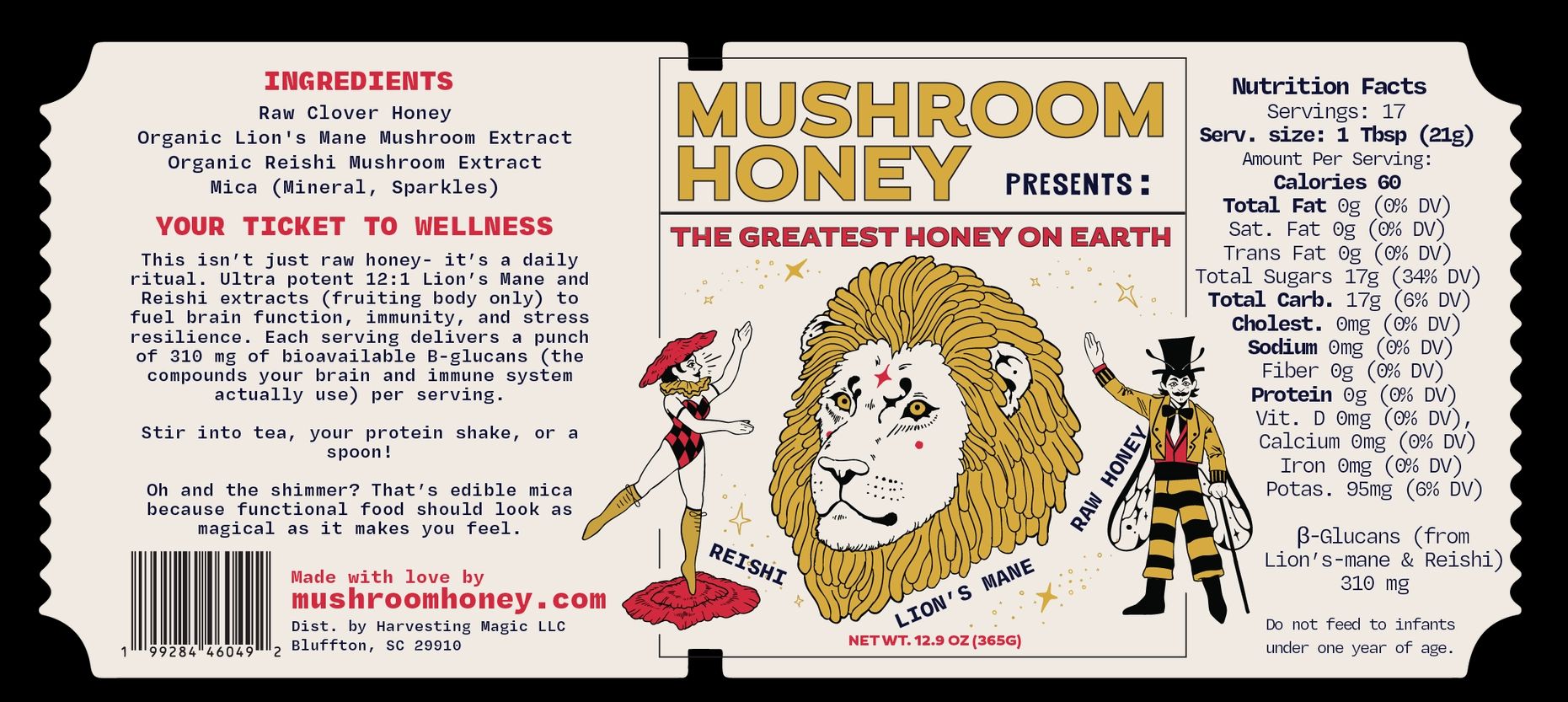
Our extracts are third-party lab tested, and the only thing in the jar that sparkles is the mica. If you want the full rundown of what's inside, it's in the Mushroom Honey FAQ.
Questions people ask next
What is the honey that makes you trip?
Two kinds of honey get that reputation. Blue honey is honey with psilocybin mushrooms steeped in it, and psilocybin is a Schedule I substance in the US. Mad honey comes from rhododendron nectar and contains grayanotoxins, which can make people sick. Functional mushroom honey made with Lion's Mane and Reishi does neither.
Is honey fungus psychedelic?
Honey fungus, or the honey mushroom (Armillaria), is a wild mushroom named for its honey-colored cap. Missouri's Department of Conservation lists it as a good edible when young and fresh, and the warning it gives is about stomach upset, so cook it thoroughly and start with a small amount.
Can Lion's Mane or Reishi make you high?
No. Psilocybin is made by a scattered group of mushrooms in the order Agaricales. Lion's Mane belongs to the Russulales and Reishi to the Polyporales, and neither produces psilocybin.
Is mushroom honey safe for babies?
No honey is. The CDC says not to give honey to children younger than 12 months because it can cause infant botulism, and that includes mushroom honey.
Sources
- [1]Electronic Code of Federal Regulations, 21 CFR 1308.11, Schedule I
- [2]Reynolds et al., “Horizontal gene cluster transfer increased hallucinogenic mushroom diversity,” Evolution Letters, 2018
- [3]NCBI Taxonomy: Hericium erinaceus, Ganoderma lucidum, Psilocybe cubensis
- [4]Bogusz et al., “Honey with Psilocybe mushrooms: a revival of a very old preparation on the drug market?”, International Journal of Legal Medicine, 1998
- [5]Lenz et al., “Injury-Triggered Blueing Reactions of Psilocybe 'Magic' Mushrooms,” Angewandte Chemie, 2020
- [6]Singapore Food Agency, “The hidden risk in honey: grayanotoxins”
- [7]Missouri Department of Conservation, Honey Mushroom field guide
- [8]National Institute on Drug Abuse, Psilocybin (Magic Mushrooms)
- [9]CDC, Foods and Drinks to Avoid or Limit (infants and toddlers)
*These statements have not been evaluated by the Food and Drug Administration. Mushroom Honey is not intended to diagnose, treat, cure, or prevent any disease. Do not feed honey to infants under one year of age.[9]